Which nest you have decides how the visit goes. An open, umbrella-shaped paper wasp nest tucked under a front-porch ceiling or behind a shutter in Ashburn Farm is the simplest case — treated and taken down in one stop.…
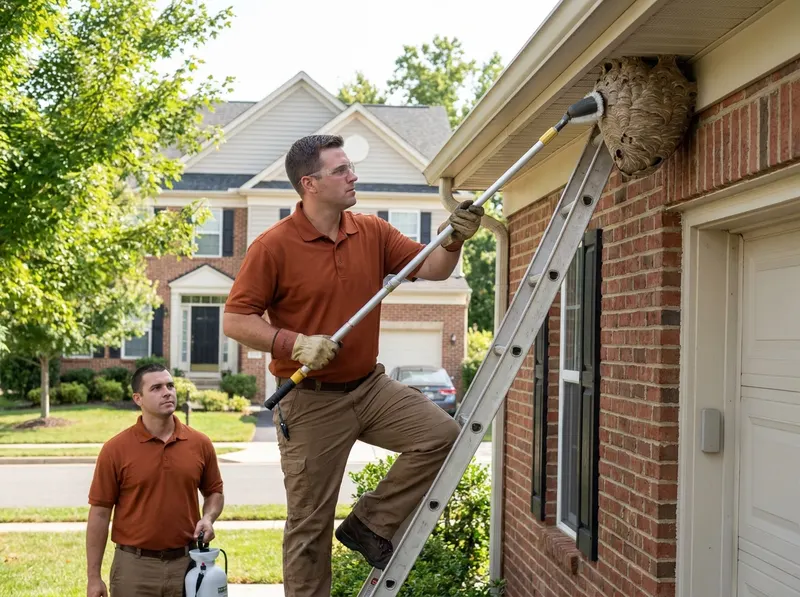
Which nest you have decides how the visit goes. An open, umbrella-shaped paper wasp nest tucked under a front-porch ceiling or behind a shutter in Ashburn Farm is the simplest case — treated and taken down in one stop. A gray football hanging in an ornamental maple or river birch in Brambleton is a bald-faced hornet colony, and those defend a wide radius, so the treatment is done at dusk or early morning when the whole colony is inside and traffic is lowest. A hole in the lawn with steady in-and-out traffic near Beaverdam Reservoir or the mulch beds along the W&OD Trail corridor is almost always a yellowjacket ground nest, which needs the underground tunnel treated rather than the visible opening sprayed.
The hardest calls in Ashburn are the ones with no visible nest. Yellowjackets and European hornets get behind vinyl siding, into gable-end soffits, and into wall voids through the weep holes in brick veneer — common in the townhouse rows in Broadlands, Moorefield Station, Loudoun Valley Estates and Farmwell Hunt, where units share walls and one colony can put pressure on two homes. In those cases the void is treated through the entry point, the opening stays open for several days so foragers carry material inward, and only then is it screened shut. Sealing a live wall nest immediately is the mistake that pushes wasps through drywall seams and light fixtures into the living room, and it is why hardware-store foam is the wrong first move.
Decide between a single-nest visit and a full exterior treatment based on how many nests you can count. If it is one nest over a door in Goose Creek Village or one under a deck rail in Belmont Ridge, single-nest removal is the right, cheaper call. If you are finding three or four builds around the same house — soffit corners, the grill enclosure, the playset, the shed eave — a perimeter and eave treatment across the whole structure costs less than stacking individual nest fees and knocks down the rebuilding cycle that runs from May through the first hard Loudoun County frost. August and September are the aggressive months: colonies peak, foragers switch to sugar, and nests over patios and near trash enclosures in One Loudoun and Ashburn Village start reacting to people who walk past.
On safety, treatments are applied per the product label to nest sites and entry points, not broadcast across lawns and flower beds. Keep children and pets indoors during application and until treated surfaces are dry, typically a few hours. If you keep a backyard hive, say so when you call so applications are placed and timed to avoid foraging bees — and again, honeybee swarms are not a pest job here. There is no requirement to sign a quarterly plan to get a nest removed; a one-time nest call is a one-time nest call.
Every job gets a firm, written price after a free on-site visit.
Tell us about your wasp and hornet nest removal job in Ashburn and we'll send a clear, written quote — usually the same day.
 Nexora Pest Control Service