Loudoun County's first hard cold snap — usually mid-to-late October — is when the phone starts ringing. Field mice living along the wooded edges near Beaverdam Reservoir, the W&OD Trail corridor, and Claude Moore Park…
Loudoun County's first hard cold snap — usually mid-to-late October — is when the phone starts ringing. Field mice living along the wooded edges near Beaverdam Reservoir, the W&OD Trail corridor, and Claude Moore Park stop finding cover outdoors and move toward warm foundations. A mouse fits through a gap the width of a pencil, so the openings that matter are the ones nobody looks at: the bottom corners of the garage door, the gap where the AC line set penetrates the siding, unscreened brick-veneer weep holes, dryer vent flaps that no longer close, and crawlspace vent frames that have pulled loose. In the newer slab-on-grade townhomes across Brambleton, Moorefield Station, and Loudoun Valley Estates, most of the traffic comes in at grade — garage corners and plumbing penetrations under the kitchen sink. In the older Ashburn Village and Ashburn Farm homes from the late '80s and '90s, we more often find settled foundation cracks, crawlspace access doors that don't seat, and soffit or gable gaps feeding attic activity.
Here's the decision that actually matters: trapping-only service versus trapping plus exclusion. Trapping-only makes sense when the activity is one or two mice that wandered in through a door left open during a move or a deck project, and the exterior inspection turns up no real openings. It's cheaper and faster. Exclusion — sealing gaps with steel mesh, hardware cloth, mortar, or door sweeps — is the right call when we find droppings in more than one room, activity in an attic or crawlspace, or three or more open entry points. The trade-off is honest: sealing costs more up front and takes longer, and it is the only part of the job that ends the problem instead of pausing it. Spray-and-bait outfits skip it because it's labor, not chemistry.
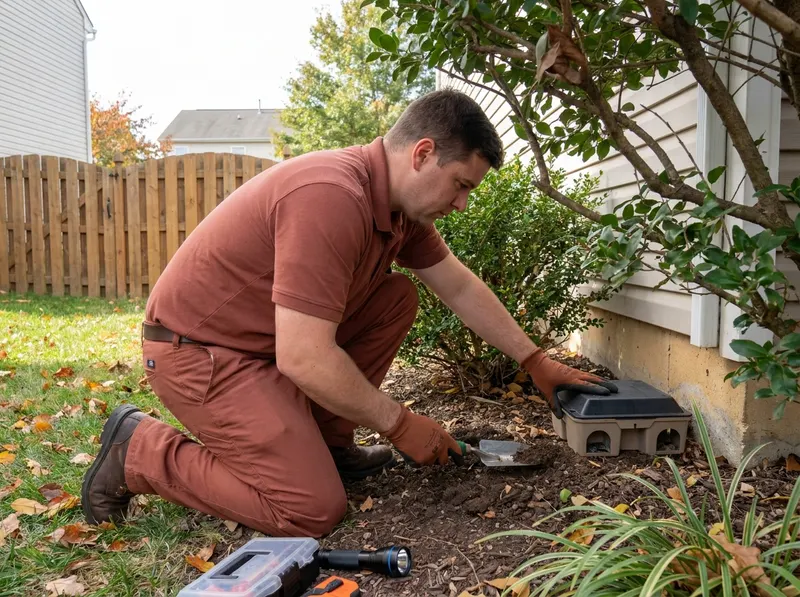
Safety drives how we place devices in an occupied Ashburn home. Inside living space we use snap traps and enclosed mechanical traps in locations a toddler or a dog can't reach — under sinks, behind appliances, in unfinished basements. We do not scatter loose bait inside a home, because a rodent that eats bait and dies inside a wall cavity becomes an odor problem you can't reach. Exterior rodenticide, where it's appropriate at all, goes in locked tamper-resistant stations along the foundation. If you keep a backyard beehive or a raised vegetable bed — common in Belmont Country Club and Goose Creek Village yards — tell us at the visit and we'll place around it.
Townhouse residents in Broadlands and One Loudoun deal with an extra wrinkle: shared walls and shared roofs mean rodents can enter through a neighbor's unsealed penetration and travel. We document what we seal on your side and note what falls to the HOA or the adjoining unit, in writing, so you have something to hand the management company. Small commercial tenants near shared dumpster corrals — restaurants and shops in One Loudoun and along the Route 7 corridor — usually need exterior station lines and door-sweep replacement more than interior trapping. Landlords facing a tenant complaint or a pre-sale inspection should call before the inspector does; documented exclusion work reads very differently on a report than a bag of traps under the sink.
Every job gets a firm, written price after a free on-site visit.
Tell us about your rodent control job in Ashburn and we'll send a clear, written quote — usually the same day.
 Nexora Pest Control Service