Exclusion is the difference between a quiet winter and a repeat call every October. Trapping and baiting handle the mice already inside; sealing handles the next twelve. In Loudoun County the pattern is predictable —…
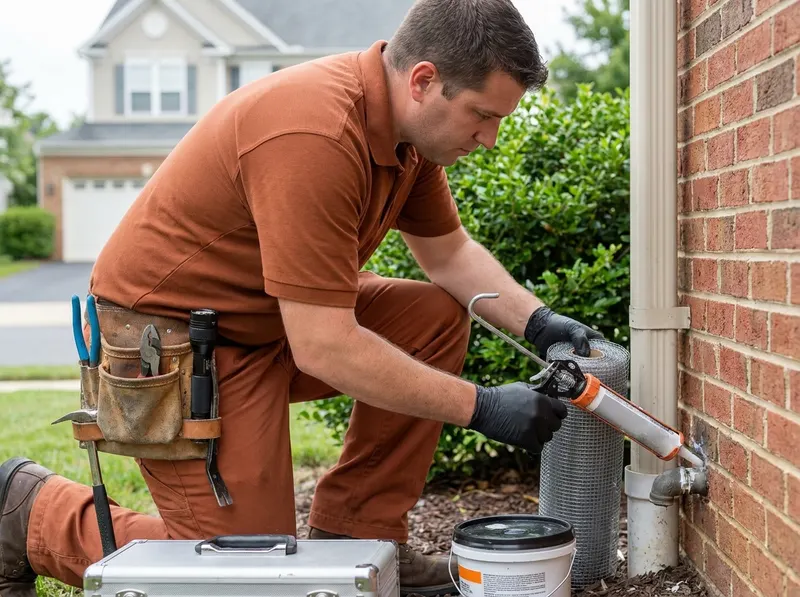
Exclusion is the difference between a quiet winter and a repeat call every October. Trapping and baiting handle the mice already inside; sealing handles the next twelve. In Loudoun County the pattern is predictable — the first hard cold snap in October pushes field mice off the brush lines along the W&OD Trail corridor and the mowed edges near Beaverdam Reservoir and Claude Moore Park, and they move toward warm foundations. Homes in Brambleton, Moorefield Station, and Loudoun Valley Estates are heavy on brick veneer over slab, and brick veneer has open weep holes by design at the bottom course. Those holes have to stay open for drainage. They do not have to stay open for mice, which is why stainless weep-hole inserts exist.
The most common opening we find on Ashburn townhomes is not exotic. It is the bottom corner of the garage door, where the rubber bulb has compressed and left a triangular gap you can see daylight through from inside. Second is the dryer vent with a broken or missing damper. Third is the HVAC line set penetration on the side wall, foamed shut with expanding foam by an installer — foam is a mouse chew toy, not a seal. In older Ashburn Village and Ashburn Farm sections we see more crawl space work: torn vent screens, a rotted access door, and sill plate gaps behind the band board. Belmont Ridge and Belmont Country Club properties on larger wooded lots tend to add roofline work, since gray squirrels and roof rats will use soffit returns and gable louvers that mice never reach.
When exclusion is the right call versus a plain treatment: if you are seeing droppings, hearing scratching in a wall, or finding chewed pantry packaging, you need both — removal first, then sealing, because sealing a house with active rodents inside just relocates the problem to your walls. If you have had no sightings but you are a landlord prepping for a turnover inspection, or you back onto open field or stormwater pond and want to get ahead of the fall, exclusion alone is reasonable and cheaper than the combined job. The honest trade-off: exclusion costs more up front than a bait station and takes longer, and no seal survives forever — decks get rebuilt, contractors run new lines, siding gets damaged by a mower. We tell customers to plan on a quick perimeter re-check every couple of years rather than pretending a house is permanently mouse-proof.
On safety and contracts, two things Ashburn homeowners ask us constantly. Exclusion is mechanical work — mesh, metal, sealant, hardware — so it introduces no rodenticide around a toddler, a dog, or a backyard hive, which is a large part of why we lead with it instead of bait. And exclusion is a one-time project priced as a project. There is no requirement to sign a quarterly agreement to have your gaps sealed. If you want ongoing monitoring afterward, that is a separate conversation you can decline.
What you get on paper: a marked list of every opening found, what material was used at each one, and what we could not reach or repair — for example a roof-level gap that needs a roofer, or a rotted band board that needs a carpenter before sealing makes sense. We would rather tell you that on day one than seal over rotten wood and let you find out in February.
Every job gets a firm, written price after a free on-site visit.
Tell us about your rodent exclusion and sealing job in Ashburn and we'll send a clear, written quote — usually the same day.
 Nexora Pest Control Service