Nexora Pest Control ServiceNexora Pest Control Service

Carpenter Bee Control

Carpenter bees pick the same targets across Ashburn every spring: the aging cedar and pine deck railings behind the 1990s homes in Ashburn Farm and Ashburn Village, unpainted fascia and pine porch columns in Broadlands…
Call (571) 934-1689 →(571) 934-1689
Carpenter Bee Control in Ashburn, VA
Quick answer
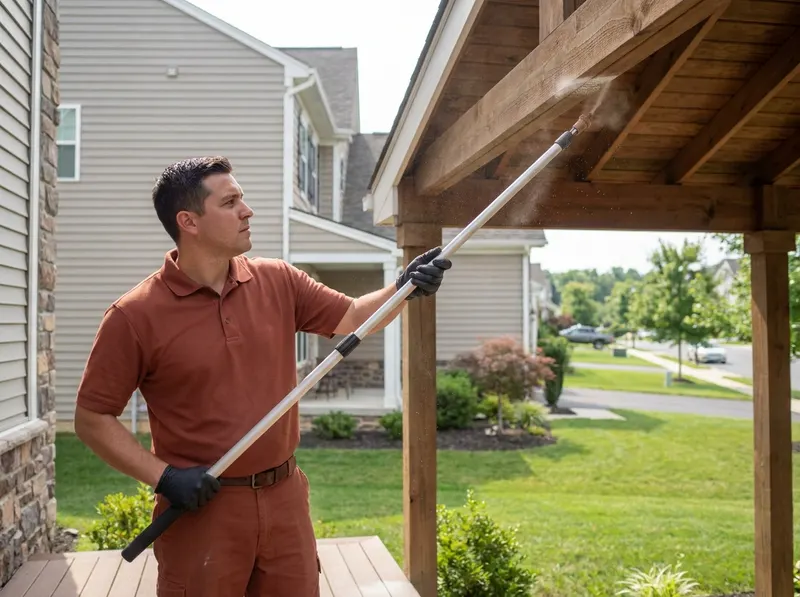
  • Included: inspection of decks, railings, fascia, soffits, pergolas, playsets and shed trim; a targeted dust applied into every accessible gallery; and plugging of treated holes once activity stops.
  • Timing: most Ashburn homes are a single visit of 45 to 90 minutes, and we can usually schedule within a few business days during the April–August season.
  • Cost: ballpark $250 to $800 depending on how many linear feet of softwood are involved and whether sealing is included — $250 is our minimum charge, and the exact figure is confirmed on a free on-site visit.
  • What we treat: the tunnels themselves, plus the bare or stained softwood surfaces the bees are re-drilling — we do not broadcast spray flowering beds, so a backyard beehive can stay where it is.
  • To book: call (571) 934-1689, describe where you see the holes and the sawdust piles, and we will tell you whether it is a one-visit job or a treat-now, seal-in-fall job.

Carpenter bees pick the same targets across Ashburn every spring: the aging cedar and pine deck railings behind the 1990s homes in Ashburn Farm and Ashburn Village, unpainted fascia and pine porch columns in Broadlands and Farmwell Hunt, and the stained pine top rails on the newer decks in Brambleton, Moorefield Station and Loudoun Valley Estates where the decking is composite but the framing and rails underneath are still softwood. South and west-facing wood takes the worst of it. If you are seeing coarse sawdust on the deck boards, a yellowish stain streaking down from a hole, or a large bee hovering in your face at the top of the stairs, that is the male — he cannot sting. The female drilling the tunnel can, but rarely does.

The decision that matters is treat-then-seal versus seal-only. Homeowners who caulk or dowel a live gallery in June usually end up with a bigger problem, because the bees chew a fresh exit sideways through the grain and the tunnel network widens. Our sequence is the opposite: dust the galleries first so the returning adults carry the product through the tunnel, leave the holes open for a short window, then plug with wood filler or a glued dowel and touch up the finish. On a deck with heavy pressure, plugging in early fall — after the second flight of adults emerges in August — holds far better than plugging in spring.

The second trade-off is treatment versus paint. Carpenter bees avoid a hard, well-painted surface; they will accept bare, weathered, or semi-transparent-stained wood all day. Treatment protects the current season and stops the tunnels from expanding. Painting or replacing the affected rail is the permanent answer, and it costs more than we do. We will tell you plainly which boards are worth sealing and which are chewed through enough that a carpenter should look at them — and if you are in an HOA-governed section of One Loudoun, Goose Creek Village or Belmont Ridge where rail color is specified, the plugs get finished to match rather than left as raw filler.

There is also a woodpecker problem attached to this one. Downy and pileated woodpeckers in Loudoun County learn to hear the larvae and open up the gallery to eat them, which turns a clean 1/2-inch hole into a torn 4-inch gash in fascia or cedar siding. Homes backing onto tree lines — the wooded edges along the W&OD Trail corridor, the older growth near Claude Moore Park, the Goose Creek side of Belmont Country Club — see this most. Treating the larvae early in the season removes the food source before the birds find it, and that is usually the difference between a $300 pest visit and a siding repair. Call (571) 934-1689 and we will walk the deck and the roofline with you before quoting anything.

What it costs

Single deck, porch, or pergola — galleries dusted$250–$350
Townhome deck plus fascia and trim treatment$275–$425
Single-family home: deck, wraparound porch, soffits and shed$375–$650
Treatment plus plugging and finish-matching of galleries$400–$800
Late-summer follow-up visit for the second flight$250–$325

Every job gets a firm, written price after a free on-site visit.

Common questions

When do carpenter bees show up in Ashburn?
Carpenter bees become active in Ashburn in April as overwintered adults leave last year's tunnels, drill and provision through May and June, and produce a second flight of adults in August. Spring is the best time to treat, and early fall is the best time to permanently plug the holes.
Is carpenter bee treatment safe around my dog and my backyard beehive in Ashburn?
Carpenter bee work in Ashburn is targeted at the drilled galleries in wood, not at flowering plants, so honey bee foraging areas are left alone. We apply into the holes and along the wood surfaces the bees are attacking, keep pets indoors during the visit, and let you know when the deck is dry and back in use.
Do I need a quarterly contract for carpenter bee control in Ashburn?
No — carpenter bee control in Ashburn is commonly handled as a standalone seasonal service, and we quote it that way. Many homes need one spring treatment and a fall sealing visit; if you want ants, mice, or mosquitoes covered too, we will price that separately so you can compare.
Should I plug the holes in my Ashburn deck railing myself?
Plug the holes only after the gallery has been treated. Sealing a live tunnel in an Ashburn deck rail usually pushes the female to chew a new exit through the side grain, which enlarges the damage. Treat first, then plug with a glued dowel or exterior wood filler and paint over it.
Which parts of an Ashburn home do carpenter bees attack most?
In Ashburn the most common targets are cedar and pine deck railings, stair stringers, unpainted fascia and soffit edges, pergolas, wooden playsets, and shed trim — especially on south and west exposures. Painted surfaces and composite decking are rarely bored, but the softwood framing behind them often is.

Ready to get started?

Tell us about your carpenter bee control job in Ashburn and we'll send a clear, written quote — usually the same day.